
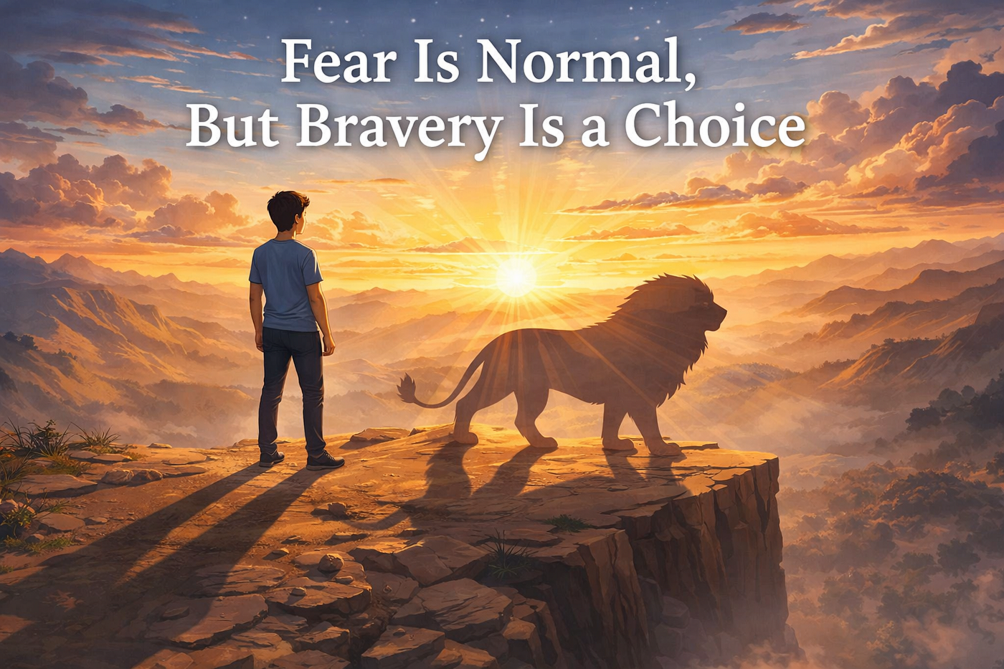
Many people believe that courage is something you are born with. They assume that brave people possess a special personality trait that allows them to face challenges without fear. We often look at successful entrepreneurs, leaders, athletes, and ordinary heroes and think, “They are naturally courageous. I could never do that.”
But the truth is far different.
Courage is not a personality trait. It is a choice.
The misconception that courage belongs only to a select few prevents many people from pursuing their dreams, speaking their truth, or taking necessary risks. In reality, courageous people experience fear just like everyone else. The difference is that they choose to act despite that fear.
The Myth of Fearlessness
When we think of courage, we often imagine someone who is fearless. Movies and stories frequently portray heroes who rush into danger without hesitation. However, real courage does not mean the absence of fear.
Fear is a natural human emotion. It exists to protect us from danger and uncertainty. Whether it is fear of failure, rejection, criticism, or loss, everyone experiences it.
The courageous person is not the one who feels no fear. The courageous person is the one who acknowledges fear and moves forward anyway.
Every major achievement in life requires stepping into uncertainty. Starting a business, changing careers, asking for help, speaking in public, or standing up for what is right all involve risk. Fear will always be present. Courage is the decision to proceed despite it.
Courage Is Built Through Action
Many people wait to feel brave before taking action. Unfortunately, that feeling rarely arrives.
Courage does not come first. Action comes first.
Think about learning to swim. No amount of reading or preparation can completely eliminate the fear of entering deep water. At some point, you must step in. The same principle applies to life.
Each small act of bravery strengthens your confidence. Every difficult conversation, every calculated risk, and every challenge faced becomes evidence that you are capable of handling discomfort.
Courage grows through practice.
The more often you choose courage, the easier it becomes to choose it again.
Everyday Courage Matters
When people hear the word “courage,” they often think of dramatic acts of heroism. Yet most acts of courage are far less visible.
Everyday courage includes:
- Saying no when everyone expects you to say yes.
- Admitting a mistake.
- Asking for feedback.
- Leaving a job that no longer aligns with your values.
- Starting over after a setback.
- Standing up for someone who cannot defend themselves.
- Pursuing a dream despite uncertainty.
These choices may not make headlines, but they shape character and determine the direction of our lives.
In many cases, the courage to take one small step can lead to extraordinary outcomes over time.
The Role of Values
One of the strongest sources of courage is clarity about what matters most.
When your values are stronger than your fears, courage becomes possible.
Consider someone who speaks up against injustice. They may feel anxious, vulnerable, or even terrified. However, their commitment to fairness outweighs their fear of consequences.
Similarly, an entrepreneur may fear failure, but their belief in their vision pushes them forward. A parent may fear uncertainty, but their desire to provide for their family gives them strength.
Courage often emerges when something becomes more important than comfort.
Courage and the Second Half of Life
As people grow older, courage takes on a different meaning.
In the first half of life, courage may involve building careers, taking risks, and chasing ambitions. In the second half, courage often means letting go of outdated identities, embracing change, and pursuing deeper purpose.
It takes courage to reinvent yourself.
It takes courage to admit that success alone is not enough.
It takes courage to begin again when others think your best years are behind you.
Some of the most inspiring stories are not about people who never failed. They are about people who chose to rise after setbacks and continue moving forward.
Choosing Courage Daily
Courage is not a one-time decision. It is a daily practice.
Every day presents opportunities to choose between comfort and growth, silence and honesty, safety and possibility.
The good news is that you do not need a special personality to be courageous. You do not need to be naturally confident, outgoing, or fearless.
You simply need to make a choice.
A choice to take the next step.
A choice to face discomfort.
A choice to act according to your values rather than your fears.
Conclusion
Courage is not reserved for heroes, leaders, or extraordinary individuals. It is available to everyone.
It is not something you inherit. It is something you decide.
The next time fear appears, remember that courage is not the absence of fear—it is the decision to move forward despite it.
Because in the end, courage is not who you are.
It is the choice you make.