
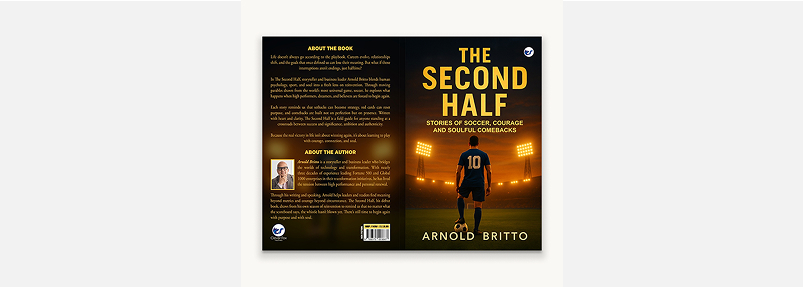
There comes a moment in many careers when momentum slows down. The energy that once fueled long hours and relentless ambition begins to feel heavy. Promotions lose their shine. Titles feel thinner. What once felt like progress now feels like pressure.
For some, this moment feels like burnout. For others, it feels like a setback — a missed opportunity, a failed venture, a job loss, or simply a silent dissatisfaction that refuses to go away.
But what if this moment isn’t the beginning of decline?
What if it’s halftime?
The Myth of Early Peak Success
Modern career culture glorifies the “first half.” Fast growth. Rapid promotions. Recognition. Achievement. Hustle. We are conditioned to believe that our most powerful years are the early ones — the years of proving, building, and climbing.
Yet in sports, halftime is not the end of the game. It is a strategic pause. A moment to reassess, recover, and reset. The scoreboard may not reflect your potential. A red card may have changed the dynamics. A missed goal may sting. But the second half offers something the first half never could: perspective.
The first half builds experience.
The second half builds wisdom.
And wisdom is power.
Burnout Is Not Failure, It’s Feedback
Many professionals reach mid-career feeling exhausted. They do not lack ability. They’ve been running under pressure instead of purpose. The second half often begins with discomfort (burnout, stagnation) or a sense of misalignment.
These are not signs that you’re falling behind. They are signals that something deeper is asking for attention.
Burnout says, “This pace is unsustainable.”
Restlessness says, “This path no longer fits.”
Setbacks say: “There’s another way.”
When you interpret these moments as feedback rather than failure, you shift from panic to possibility.
The Power of Pause
In the first half of life, speed feels like strength. In the second half, pause becomes power.
A pause allows you to:
- Reflect on what truly matters.
- Redefine success on your own terms.
- Release identities that no longer serve you.
- Reconnect with your deeper motivations.
This is not quitting. It is recalibrating.
Many of the most meaningful career transitions don’t happen because someone chases more. They happen because someone slowed down long enough to ask better questions. These questions are as follows:
- Who am I now?
- What do I value?
- What kind of impact do I want to create?
The second half invites depth over display.
From Hustle to Healing
Early career phases often revolve around proving yourself — to managers, family, peers, even to your younger self. The second half invites a different energy: healing.
Healing from comparison.
Healing from perfectionism.
Healing from the belief that worth equals productivity.
When you stop performing and start aligning, your work gains authenticity. Decisions become intentional rather than reactive. You move from external validation to internal clarity.
And clarity is more sustainable than ambition alone.
Setbacks Become Strategic Advantages
In soccer, a missed goal can change the rhythm of the game. But it can also sharpen focus. Players adjust tactics. Teams communicate differently. Strategy evolves.
In careers, setbacks function the same way.
A failed startup teaches resilience and market awareness.
A demotion builds humility and technical depth.
A job loss forces reinvention.
These experiences are painful in the moment. But they cultivate emotional intelligence, adaptability, and courage, the same qualities that define powerful leadership in the second half.
You are no longer just skilled.
You are seasoned.
Redefining Winning
In the first half, winning often means status, salary, and speed.
In the second half, winning may look like:
- Work that aligns with your values.
- Time for health and relationships.
- Meaningful contribution over constant competition.
- Peace over pressure.
The shift is subtle but profound. You move from chasing metrics to creating meaning.
And meaning sustains energy far longer than ambition alone.
The Courage to Start Again
One of the greatest fears that mid-career professionals face is starting over. There is an ego attached to experience. There is comfort in familiarity. There is risk in reinvention.
But the second half is not about erasing the first half. It’s about building on the experiences of the first half.
Your experience becomes a foundation; it should not be treated as baggage.
Your lessons become tools, not regrets.
Your pauses become preparation.
Starting again in the second half is not regression. It is refinement.

Your Best Plays May Still Be Ahead
The most powerful phase of your career is not defined by age. It is defined by awareness and consciousness.
When you:
- Trade hustle for healing,
- Pressure for presence,
- Perfection for purpose,
You begin to operate from alignment rather than anxiety.
The second half is where identity becomes intentional. Where confidence is silent. Where work becomes integrated with who you are, not separate from it.
It is where you stop asking, “How do I win?”
And start asking, “What truly matters?”
And in that shift, something remarkable happens:
You stop playing to survive.
You start playing to serve.
And that is where your most powerful phase begins.